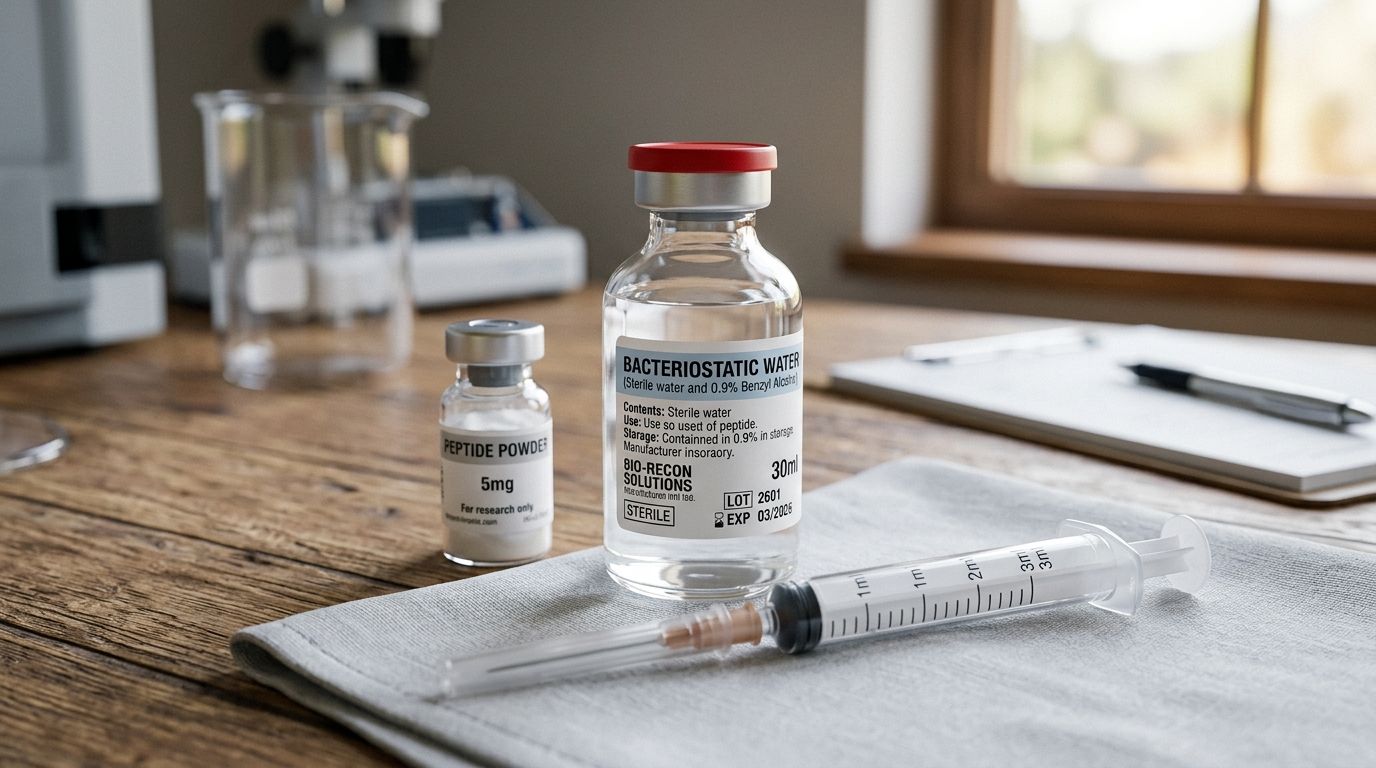
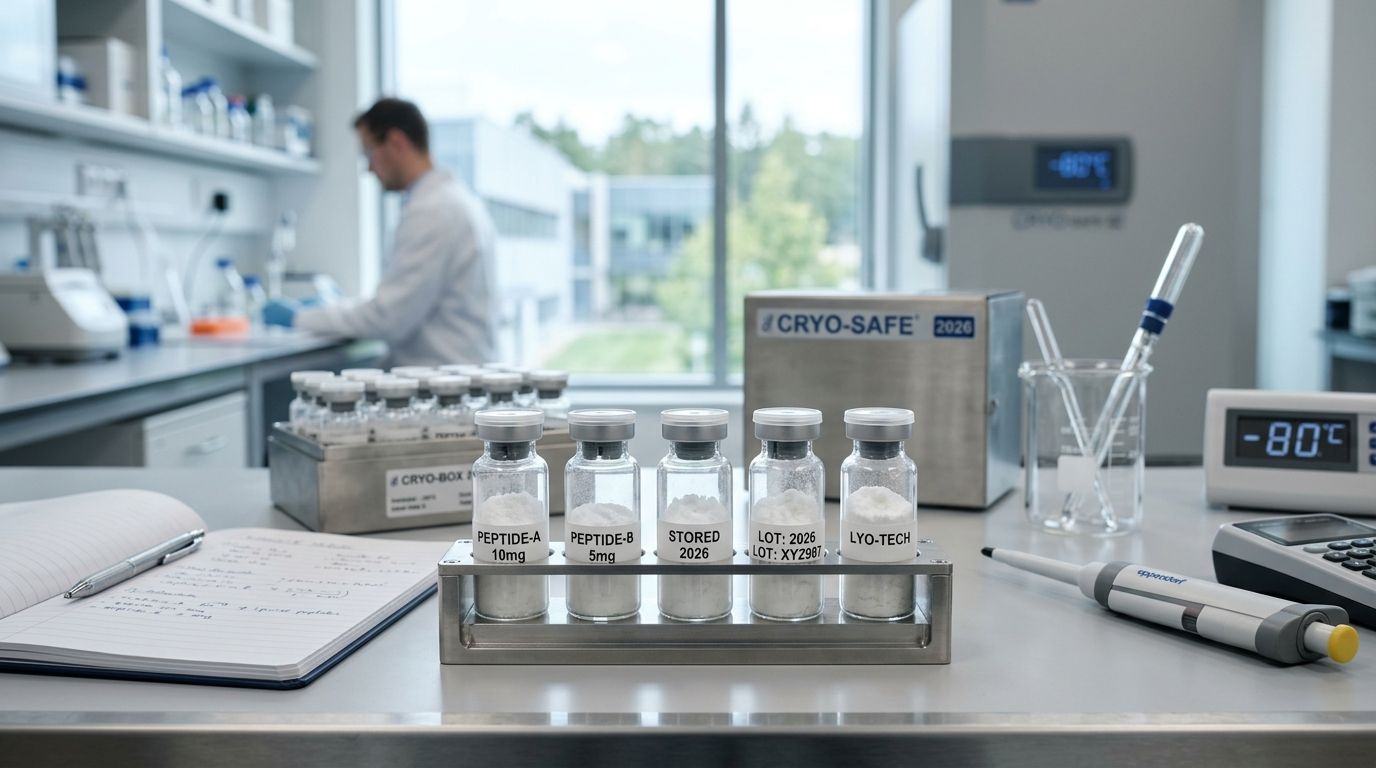
Choosing the right lyophilized peptide for long-term freezer storage comes down to molecular stability, chain length, and how well the compound tolerates freeze-thaw cycles — not brand loyalty. This guide ranks the peptides research labs most often stock for extended storage in 2026, based on established peptide chemistry and handling data.
- BPC-157 is the best overall pick among lyophilized peptides for long-term storage, with a well-documented -20°C stability profile.
- TB-500 (Thymosin Beta-4) holds up best among larger-chain peptides when kept lyophilized and light-protected.
- Retatrutide suits labs running GLP-1/GIP/glucagon triple-agonist protocols that need multi-month bench stability.
- SLU-PP-332 is the top choice for ERR agonist research where reconstitution timing matters less than shelf life.
- Reconstituted peptides degrade faster than lyophilized powder — plan aliquots around a 2-4 week working window regardless of which compound you choose.
Why this matters
Lyophilization removes water from a peptide through freeze-drying, and that single step is what separates a compound that holds its purity for 24 months at -20°C from one that degrades within days at room temperature. Labs ordering research peptides for anything longer than a single-week assay need to know which compounds tolerate the freezer and which ones demand near-immediate use after reconstitution.
The difference isn't cosmetic. A peptide that partially degrades in storage skews concentration calculations, throws off dosing curves in animal models, and wastes a purchase order. Best lyophilized peptides for 2026 research work are the ones with published, repeatable stability behavior — not the ones with the flashiest marketing copy.
What makes the best lyophilized peptide for storage
- Chain length and structural complexity — shorter, simpler sequences generally tolerate freeze-thaw cycling better than large, multi-domain peptides.
- Moisture sensitivity — lyophilized powder must stay sealed and desiccated; humidity exposure accelerates hydrolysis.
- Light sensitivity — copper-binding and aromatic-residue-heavy peptides degrade faster under ambient light.
- Third-party purity verification — a certificate of analysis confirming purity at the time of lyophilization gives you a real baseline to measure degradation against.
- Cold-chain shipping practice — peptides that arrive already compromised in transit never reach their full storage window.
- Documented reconstitution behavior — compounds with a known, consistent solubility profile are easier to standardize across a lab's protocols.
Best lyophilized peptides for storage: at a glance
| Peptide | Best for | Standout feature | Key limitation |
|---|---|---|---|
| BPC-157 | General stability benchmarking | Short 15-residue chain, well-characterized degradation curve | Still requires light protection despite short chain |
| TB-500 (Thymosin Beta-4) | Larger peptide chain storage | 43-amino acid actin-binding sequence with documented lyophilized stability | More sensitive to repeated freeze-thaw than short peptides |
| Retatrutide | Multi-agonist GLP-1 research | Triple-agonist (GLP-1/GIP/glucagon) activity in one compound | Complex structure demands stricter cold-chain discipline |
| SLU-PP-332 | ERR agonist protocols | Small-molecule stability, less prone to hydrolysis than long peptide chains | Newer research compound with a thinner published literature base |
| GHK-Cu | Copper-peptide storage | Tripeptide-copper complex with a distinct, trackable degradation signature | Highly light-sensitive; requires amber vial storage |
| Semaglutide | GLP-1 receptor agonist category | 31-amino acid sequence with extensive published stability data | Reconstituted solution has a short usable window |
1. BPC-157: best lyophilized peptide for general stability benchmarking
BPC-157 is a 15-amino acid partial sequence studied widely enough in 2026 research literature that its lyophilized degradation curve is close to a known quantity. Labs use it as a baseline compound when validating storage protocols before moving on to less-characterized peptides.
BPC-157 pros:
- Short chain length means fewer degradation pathways to monitor
- Extensive published handling data to benchmark against
- Straightforward reconstitution behavior in standard research solvents
BPC-157 cons:
- Still requires -20°C or colder storage to hit the full stability window
- Light exposure during handling accelerates breakdown even in short sequences
Best for: labs establishing a baseline storage protocol before scaling to multiple peptide types. Verdict: Buy.
2. TB-500 (Thymosin Beta-4): best for larger peptide chain storage
Thymosin Beta-4, marketed as TB-500 in research contexts, is a 43-amino acid peptide — nearly three times the length of BPC-157. Larger chains have more folding complexity and more sites where hydrolysis or oxidation can occur, so storage discipline matters more here than with shorter compounds.
TB-500 pros:
- Well-documented actin-binding activity supports consistent research protocols
- Lyophilized form holds up reliably at -20°C when sealed against moisture
- Widely stocked, so batch-to-batch purity data is easier to compare
TB-500 cons:
- More freeze-thaw sensitive than shorter-chain peptides
- Requires stricter desiccant packaging to avoid moisture-driven degradation
Best for: labs running longer protocols that need a larger peptide with a track record. Verdict: Buy.
3. Retatrutide: best for multi-agonist GLP-1 research storage
Retatrutide is a triple-agonist compound acting on GLP-1, GIP, and glucagon receptor pathways, which makes it structurally more complex than single-target GLP-1 peptides. That complexity is exactly why cold-chain discipline matters more here — a compound targeting three receptor pathways has more structural features that can shift under poor storage conditions.
Retatrutide pros:
- Covers three receptor targets in a single research compound
- Growing body of 2026 literature on its GLP-1 pathway research applications
- Lyophilized form storable at -20°C to -80°C for extended timelines
Retatrutide cons:
- More structurally complex than single-agonist peptides, demanding tighter handling protocols
- Published long-term stability data is thinner than for older, single-target peptides
Best for: research protocols specifically studying multi-receptor GLP-1/GIP/glucagon activity. Verdict: Buy, with strict cold-chain handling.
4. SLU-PP-332: best for ERR agonist research storage
SLU-PP-332 functions as a synthetic ERR (estrogen-related receptor) agonist. Because it behaves more like a small-molecule compound than a long peptide chain, it sidesteps some of the hydrolysis risks that come with amino acid chains of 30+ residues.
SLU-PP-332 pros:
- Small-molecule structure reduces exposure to peptide-specific degradation pathways
- Stable in lyophilized form across standard -20°C freezer storage
- Straightforward to standardize across ERR agonist research protocols
SLU-PP-332 cons:
- Less published long-term stability data compared to established peptides like BPC-157
- Newer compound means fewer third-party reference points for cross-lab comparison
Best for: labs running ERR agonist mechanism studies that need a compound less prone to chain hydrolysis. Verdict: Buy.
5. GHK-Cu: best for copper-peptide storage protocols
GHK-Cu is a copper-binding tripeptide (glycyl-L-histidyl-L-lysine bound to copper), and that copper complex is what makes it uniquely light-sensitive compared to standard amino acid chains. Amber vial storage isn't optional here — clear packaging shortens the usable window fast.
GHK-Cu pros:
- Short tripeptide backbone limits hydrolysis-driven degradation
- Copper-binding behavior gives a clear, trackable degradation signature for quality checks
- Well-suited to -20°C long-term storage once light exposure is controlled
GHK-Cu cons:
- Highly sensitive to ambient light — degrades faster than non-metal-binding peptides
- Requires amber or opaque vial packaging that adds a handling step most labs skip with other peptides
Best for: copper-peptide research protocols where light-controlled storage is already standard practice. Verdict: Buy, with amber-vial storage only.
6. Semaglutide: best for GLP-1 receptor agonist category research
Semaglutide is a 31-amino acid GLP-1 receptor agonist with one of the deepest published stability records of any compound on this list, simply because of how widely it has been studied since its initial development. That track record makes it a reliable reference point when comparing newer GLP-1 pathway peptides.
Semaglutide pros:
- Extensive published stability and handling data across research settings
- Predictable lyophilized storage behavior at -20°C
- Useful as a comparison baseline for newer GLP-1 category peptides
Semaglutide cons:
- Reconstituted solution has a short usable window, same as most GLP-1 peptides
- Widely available, so purity verification across suppliers becomes the deciding factor
Best for: labs benchmarking newer GLP-1 pathway compounds against an established reference peptide. Verdict: Buy.
How this list was ranked
Each peptide above was weighed against the six criteria listed earlier: chain length, moisture sensitivity, light sensitivity, purity verification, cold-chain shipping practice, and reconstitution consistency. Shorter, well-characterized peptides like BPC-157 rank higher on ease of storage; structurally complex compounds like Retatrutide rank lower on simplicity but higher on research value for labs that specifically need multi-target activity.
Source verified lyophilized peptides
Third-party tested, 99% purity peptides for research use only.
Which lyophilized peptide should you choose?
If your lab needs one default pick for 2026, BPC-157 remains the best overall lyophilized peptide for long-term storage — short chain, well-documented degradation profile, straightforward -20°C handling. If your protocol specifically studies larger peptide chains, TB-500 is the better fit. Multi-target GLP-1 work points to Retatrutide, and ERR agonist studies point to SLU-PP-332. Whichever compound you land on, the storage rule doesn't change: keep it lyophilized, keep it cold, keep it dark, and don't reconstitute more than you'll use inside a few weeks.
FAQ
What are the best lyophilized peptides for long-term storage in 2026?
BPC-157, TB-500, and Retatrutide rank among the best lyophilized peptides for long-term storage in 2026 due to documented stability at -20°C and below. Chain length and light sensitivity determine how well each compound tolerates extended freezer storage.
How long do lyophilized peptides last in storage?
Lyophilized peptides typically remain stable for up to 24 months when stored at -20°C to -80°C and protected from light and moisture. Reconstituted peptide solutions have a much shorter usable window, usually 2-4 weeks.
Is BPC-157 more stable than TB-500 for long-term storage?
BPC-157's shorter 15-amino acid chain generally tolerates freeze-thaw cycling better than TB-500's larger 43-amino acid structure. Both are stable in lyophilized form at -20°C, but TB-500 demands stricter moisture control.
Why does light exposure matter for peptide storage?
Light accelerates oxidation in peptides with aromatic residues or metal-binding sites, such as GHK-Cu. Storing lyophilized peptides in amber or opaque vials away from ambient light extends their usable shelf life.
Should peptides be stored at -20°C or -80°C?
Most lyophilized peptides remain stable within the -20°C to -80°C range, with -80°C offering a wider safety margin for long-term archival storage. -20°C is sufficient for most active research timelines under 24 months.
Does reconstituting a peptide shorten its storage life?
Yes. Once reconstituted, a peptide solution should generally be used within 2-4 weeks even under refrigeration, compared to up to 24 months for the lyophilized powder. Reconstitute only the amount needed for near-term protocols.
What's the difference between GHK-Cu and other lyophilized peptides for storage?
GHK-Cu's copper-binding structure makes it more light-sensitive than standard amino acid chains, requiring amber vial storage that most other lyophilized peptides don't strictly need. Its short tripeptide backbone otherwise resists hydrolysis well.
Is third-party testing important when sourcing lyophilized peptides?
Yes, a certificate of analysis confirming purity at the point of lyophilization gives researchers a real baseline to measure degradation against over the storage window. Without it, there's no way to distinguish supplier variability from actual storage-related breakdown.
One last thing
The compound matters less than the freezer door. Most purity loss reported in 2026 research handling logs traces back to repeated freeze-thaw cycling and inconsistent light exposure, not to which peptide was chosen in the first place — aliquot before you freeze, and you'll extend the usable life of any peptide on this list.